What is a normal menstrual cycle?
A 28-day cycle isn’t the only normal one. Learn the ranges doctors use today and when to see a gynecologist.
Published Updated 3 min read

“My cycle is 32 days long—is that normal?” This is a very common question. The idea of a “right” 28-day cycle is firmly lodged in our minds, even though most women have a different cycle length. Let’s look at the ranges gynecologists use today and when it’s worth seeing a doctor.
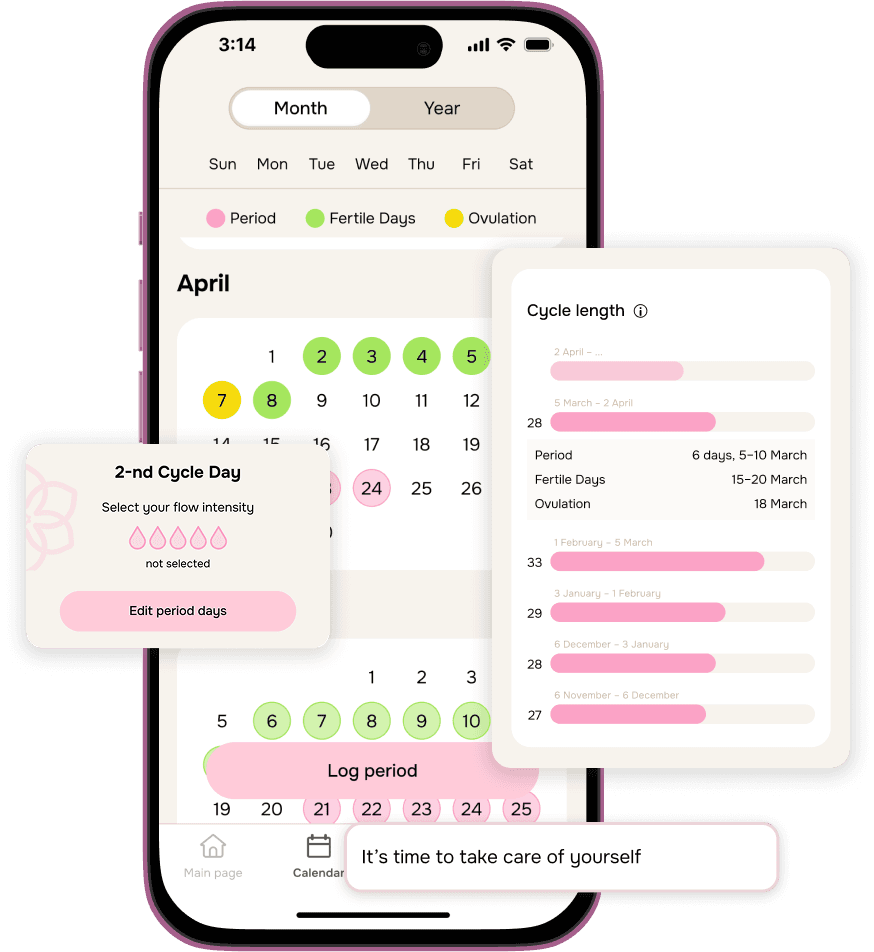
Count your cycle from the first day of one period to the first day of the next
The count starts on the first day of bleeding. Spotting the day before usually doesn’t count. The day before your next period is the last day of the cycle.
A normal cycle lasts 24 to 38 days
In 2018, the International Federation of Gynecology and Obstetrics updated its definitions of a normal cycle. Doctors now use these measures:
- A cycle lasts 24 to 38 days.
- Your period lasts no more than 8 days.
- The difference between your shortest and longest cycles is no more than 7–9 days, depending on your age, as the StatPearls reference explains.
- The amount of bleeding doesn’t interfere with your usual activities.
- There’s no bleeding between periods.
Older sources often give a range of 21 to 35 days, and you may still see it in articles. The newer FIGO ranges reflect reality more accurately.
Exactly 28 days is uncommon
In a study of more than 600,000 cycles published in npj Digital Medicine, the average cycle length was 29.3 days, and only 13% of cycles lasted exactly 28 days. Cycles usually become a little shorter with age.
Teenagers have different norms
In the first few years after periods begin, cycles are still settling into a pattern. The American College of Obstetricians and Gynecologists (ACOG) considers a cycle of 21 to 45 days and bleeding for up to 7 days normal for teenagers. See a doctor if there’s no period for 3 months, bleeding lasts longer than 7 days, or a pad needs changing every 1–2 hours.
When to see a gynecologist
- Your cycle is shorter than 24 days or longer than 38 days for several months in a row.
- Your period lasts longer than 8 days.
- You haven’t had a period for 3 months or more.
- You have bleeding between periods or after sex.
- Your periods have become very heavy or painful.
- Your cycle has changed suddenly without an obvious reason.
A cycle calendar can also help with worship
It’s helpful for Muslim women to record when each episode of bleeding starts and ends. These notes aren’t only useful for your gynecologist. They can also help you tell when your period has ended and it’s time to perform ghusl (the ritual bath), how many days of fasting you need to make up, and how to distinguish hayd (menstruation) from istihada (bleeding outside menstruation). Aisha reported that women were instructed to make up missed fasts, but not prayers, and, according to at-Tirmidhi, all scholars agree on this. The rules for hayd and istihada differ between schools of thought, so keeping records can make it easier to consult an imam or an alima (female scholar).

Your cycle is unique. Knowing what’s normal for you is more useful than comparing yourself with a number in a textbook. If something changes, don’t wait—get it checked.
This article is for information only and does not replace advice from a doctor. If something worries you, talk to a healthcare professional.