What is the fertile window, and how can you calculate it?
The fertile window lasts only a few days around ovulation, but it can be hard to predict from the calendar alone. Learn what affects it and how to identify your fertile days.
Published Updated 3 min read

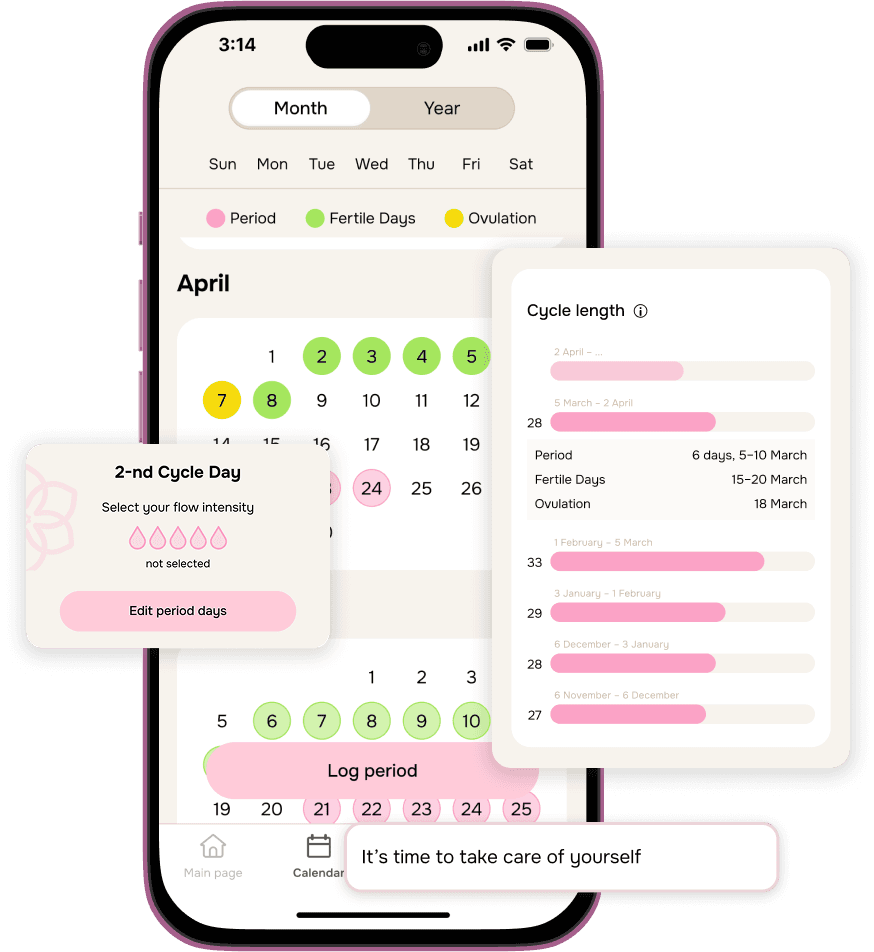
You can get pregnant not on every day of your cycle, but only during the few days around ovulation. These days are called the fertile window. Knowing about it can help couples who are hoping for a baby, as well as those who want to avoid pregnancy. Here’s how the fertile window works and why it’s hard to calculate from the calendar.
The fertile window lasts about 6 days
In 1995, American epidemiologist Allen Wilcox and his colleagues published a study in the New England Journal of Medicine in which women provided urine samples every day to determine when they ovulated. They found that pregnancy occurred only after sex during a 6-day period, ending on the day of ovulation. The chances were highest in the 2 days before ovulation and on the day itself.
That’s because sperm can survive in a woman’s body for up to 5 days, while an egg remains capable of being fertilized for about 12–24 hours after it leaves the ovary.

Fertile days are unpredictable
Many people think the fertile days are days 10–17 of the cycle. Five years after their first study, Wilcox and his colleagues showed in the British Medical Journal that the fertile window can fall on almost any day of the cycle. For only 30% of women did it fall entirely within the usual window of days 10–17. Even with a regular cycle, ovulation can shift because of stress, illness, travel, or lack of sleep.
Signs can help you identify fertile days more accurately
- Discharge becomes clear, slippery, and stretchy.
- An ovulation test detects a surge in luteinizing hormone.
- After ovulation, basal body temperature rises and stays high until your period.
Using these signs together with a calendar gives you a clearer picture than relying on any one of them alone. A cycle-tracking app can help you keep all your observations in one place, though it can’t guarantee an accurate prediction.

Couples hoping for a baby don’t need to count every day
The American College of Obstetricians and Gynecologists (ACOG) recommends having sex every 1–2 days during the fertile window. Having sex every day is not necessary, and constantly counting the days can make intimacy feel like an obligation and add anxiety. If pregnancy hasn’t occurred after a year of regular sex—or after 6 months if you’re over 35—both partners should see a doctor.

Your period and fertile window can sometimes be close together
Vaginal intercourse during menstruation is prohibited in Islam, as stated in verse 222 of Surah al-Baqarah. Pregnancy during this time is unlikely, but with a short cycle—for example, 21–24 days—the fertile window may begin just a few days after bleeding ends. This matters both for those planning a pregnancy and for those who want to avoid one.
If you use knowledge of the fertile window as a method of contraception, keep in mind that with typical use, natural methods result in about 24 pregnancies per 100 women each year. If pregnancy would be inadvisable for your health right now, talk with a gynecologist about a more reliable method.
The fertile window is a reminder of how finely the body is designed. Understanding these processes can make family planning calmer and more intentional for both partners.
This article is for information only and does not replace advice from a doctor. If something worries you, talk to a healthcare professional.